


Many people believe that a ‘comfortable’ chair must feel one thing above all else: soft. Yet this is precisely where a widespread misconception begins. True ergonomic seating comfort does not come from yielding and sinking in, but from targeted support, pressure distribution and an active posture. Find out here why soft upholstery can actually be counterproductive – and what constitutes real comfort.
1. The comfort fallacy: Soft = comfortable?
Soft upholstery feels pleasant at first. It gives way quickly, moulds to your body – and thus creates a false impression of comfort.
But after 20, 30 or 60 minutes, the problem becomes apparent:
- The muscles have to compensate for the lack of support
- The body sinks into an unergonomic posture
- Pressure points develop on the sit bones and thighs
- You start to slide restlessly back and forth
The result: tension, fatigue and often even increased back pain.
Ergonomics experts therefore agree: comfort is not a feeling of softness – comfort is the absence of discomfort.
2. What really defines ergonomic seating comfort
True seating comfort is based on biomechanical factors – not on the softness of the upholstery.
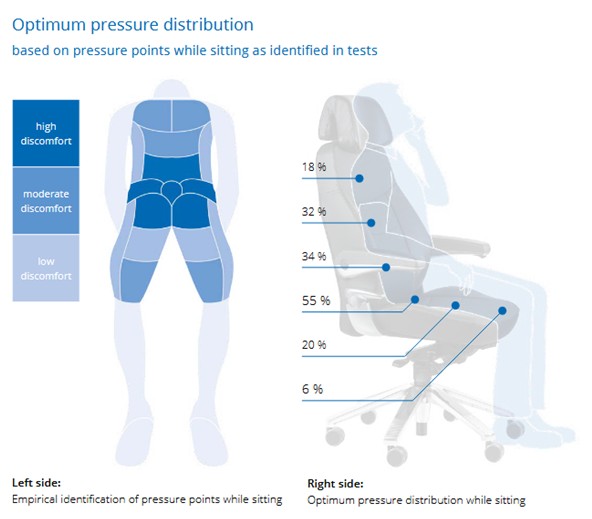
Optimal pressure distribution
High-quality chairs use carefully calibrated cushion firmness and ergonomic seat shapes to distribute pressure evenly. This maintains blood circulation and keeps the muscles relaxed.
Body-contoured support
A good chair provides support where the body needs it – the pelvis, lumbar spine and upper back.
The more stable the support, the less the muscles tense up.
Active sitting instead of sinking
Active micro-movements keep the back muscles relaxed.
Stiff sitting – or sinking deep into the chair – prevents these beneficial movements.
Long-term comfort instead of the sofa effect
What feels soft and cosy at first is often unsuitable for prolonged use. Ergonomic comfort develops over hours – not in the first few minutes.
3. Why Svenstol deliberately avoids ‘soft’ designs
Svenstol chairs, whether office or 24-hour models, deliberately focus on:
- High-quality upholstery with defined support zones
- ActivePlus mechanism for relaxed and active sitting
- Stable support for the pelvis and back
- Durable upholstery with shape retention
The result is a seating experience that initially feels firmer – but proves to be significantly more comfortable and healthier over the course of hours.
Or to put it another way: chairs for everyday use, not for making an impression in the showroom.

Conclusion:
Soft feels good – but it’s rarely ergonomic
Anyone who sits for long periods – and most people do so in their everyday working lives – needs support rather than sinking into the seat.
An ergonomic chair is therefore:
- not soft, but suitably firm,
- not yielding, but supportive,
- not cosy at first, but comfortable over many hours.
And that is exactly what Svenstol chairs stand for.


